How Deep Should a Wardrobe Be? Hinged, Sliding, Shelved
Short answer: the standard wardrobe depth is 60-62 cm (external body size). Once you subtract the back panel and the door thickness, the usable internal depth is 55-58 cm — and the 50-55 cm shoulder width of a garment on a hanger fits that space exactly. In wardrobes with sliding doors the runners take up 8-10 cm, so the body goes up to 65-70 cm. A module with shelves only and no hanging rail needs just 40-45 cm. In wardrobes under 50 cm deep, the rail is fitted front to back (perpendicular to the wall) rather than across.
The figures do not change with the word you search for: "wardrobe depth", "closet depth" and "clothes cupboard depth" all point to the same numbers.
Depth table by wardrobe type
| Wardrobe type | External depth | Usable internal depth | Hanging layout |
|---|---|---|---|
| Standard wardrobe with hinged doors | 60-62 cm | 55-58 cm | Rail across the width |
| Sliding-door wardrobe | 65-70 cm | 55-60 cm | Across; runners take 8-10 cm |
| Shelf / drawer module only | 40-45 cm | 36-42 cm | No rail, folded clothes |
| Shallow wardrobe (narrow room, hallway) | 45-50 cm | 41-46 cm | Front-to-back rail |
↔ Scroll the table sideways to see all of it.
All the width and height figures by door count are in our standard wardrobe sizes table article.
Why 60 cm? The shoulder, hanger and door calculation
60 cm is not a figure to memorise; it is the sum of three measurements:
- Hanger shoulder width: 42-45 cm.
- Thickness of the garment: +8-12 cm. A shirt slips in easily, while a winter coat on a hanger reaches 55 cm.
- Door and back panel: 3-4 cm.
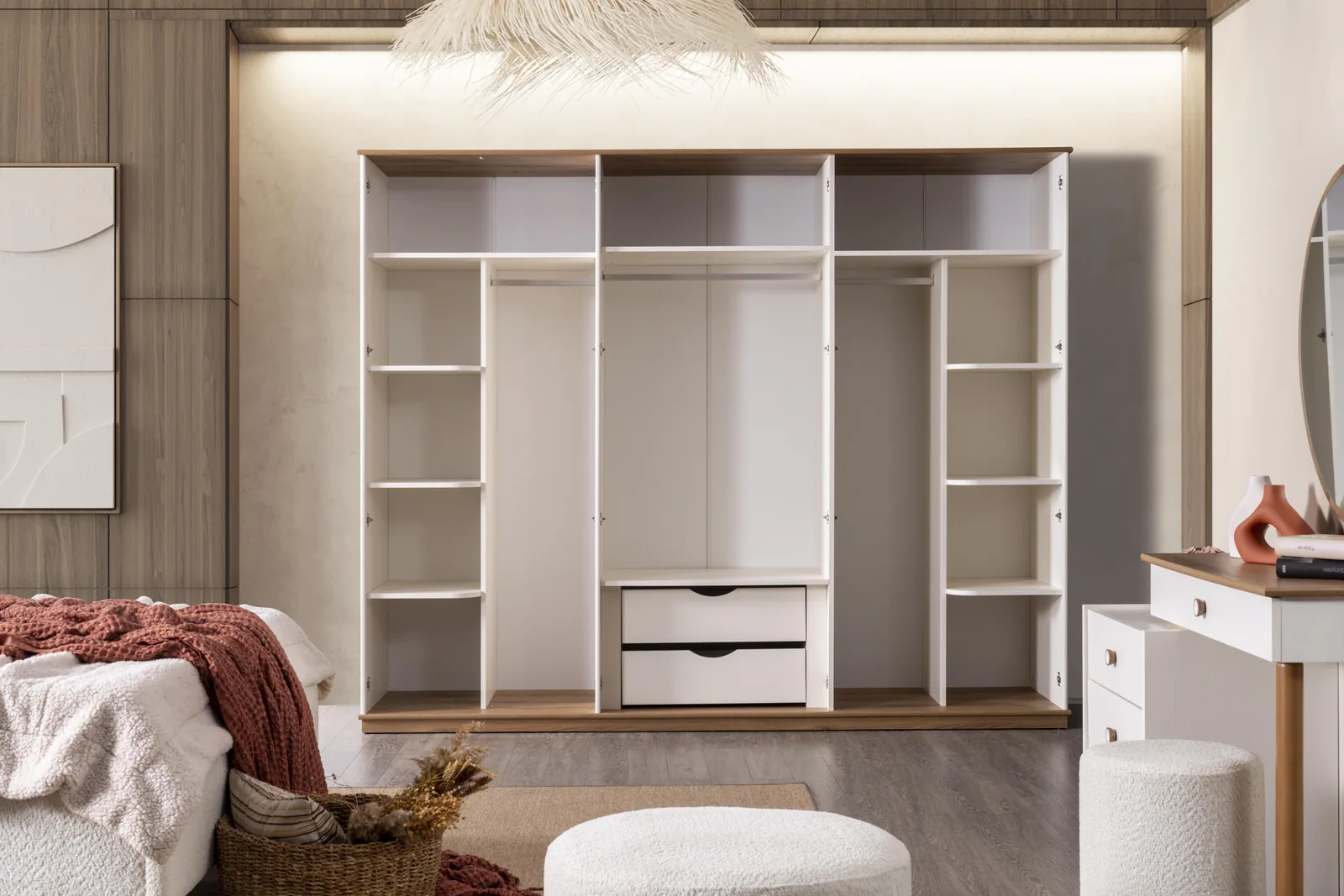
55 + 4 ≈ 60 cm. Once the body goes below that, hangers sit at an angle, the shoulders of the clothes rub against the door and the door will not close properly. For example, the Rams 4-door wardrobe is produced with a 173 × 68 × 215 cm body; 68 cm is the top end of the comfortable band for anyone hanging coats.

Why are sliding-door wardrobes deeper?
A sliding door travels in front of the body. The door, the runner profile and the clearance for the two doors to pass one another take up 8-10 cm in total. So a sliding wardrobe with a 68 cm body has a usable internal depth of 58-60 cm — almost the same as a 62 cm hinged one.
The rule for deciding: sliding doors take depth from the room but reduce the door swing to zero. If you cannot free up 150 cm in front of the wardrobe, those 6-8 cm are worth giving away.
When does a shallow wardrobe (40-50 cm) do the job?
- Folded clothes only: jumpers, T-shirts and bedding sit fine on a 40-45 cm shelf; with no rail, the back of the shelf would be dead space anyway.
- Hallway and entrance cupboards: 45-50 cm is preferred so the passage is not narrowed.
- Narrow bedrooms: in a 45-50 cm body the rail is fitted perpendicular to the wall and clothes hang one behind the other. Capacity drops, but the hangers do not sit at an angle.
If your room is in the 10-12 m² band, take a look at our how to fit a bedroom set into a small room article.
The clearance to leave in front of the wardrobe
The floor area a wardrobe really takes is not the depth of its body; a hinged door swings out into the room by its own width.
- Hinged: 62 cm body + 42-50 cm door + 40 cm for the user ≈ 150 cm.
- Bi-fold: the swing halves, ≈ 125 cm.
- Sliding: nothing projects forward; 68 cm body + user clearance ≈ 110 cm.
If that distance is not there between the foot of the bed and the wardrobe, you will not be able to open the doors fully.
Depth, width and height are read together
Depth is close to fixed (60-68 cm); the variable is width:
- 2 doors: 85-100 cm, height 215-226 cm.
- 3 doors: 128 cm.
- 4 doors: 170-200 cm — the most-chosen configuration.
- 6 doors: 260-300 cm; the wall needs at least 270 cm uninterrupted.
For how many doors you should go for, see the table in our how many doors should a bedroom wardrobe have article. If you want to compare models by their dimensions, the body size of every product is listed on the wardrobe models and bedroom sets pages.
Frequently Asked Questions
How deep should a wardrobe be?
60-62 cm if you are going to hang clothes. That figure is the sum of the hanger shoulder (42-45 cm), the thick garment on it (+8-12 cm) and the thickness of the door and back panel (3-4 cm). Sliding-door models need 65-70 cm, and shelf-only modules 40-45 cm.
Is 50 cm deep enough for a wardrobe?
Not for a rail across the width. In a 50 cm body the internal depth drops to 46 cm and the shoulders of thicker garments rub against the door. The answer is to fit the rail perpendicular to the wall, or to make that module shelves only.
How deep is a sliding-door wardrobe?
The body is 65-70 cm and the usable internal depth 55-60 cm. Because the runner system takes 8-10 cm, it looks deeper from outside while giving the same usable space inside as a hinged wardrobe.
What is the internal depth of a wardrobe?
55-58 cm in a 62 cm body. The difference comes from the back panel, the inner face of the door and the shelf supports. The depth on the label is always the external measurement.
Will jackets and coats fit at standard depth?
Yes. In a 60-62 cm body, jackets and shirts sit comfortably and a thick coat fills the space exactly. If you use coats a lot, models 65-68 cm deep are more comfortable.