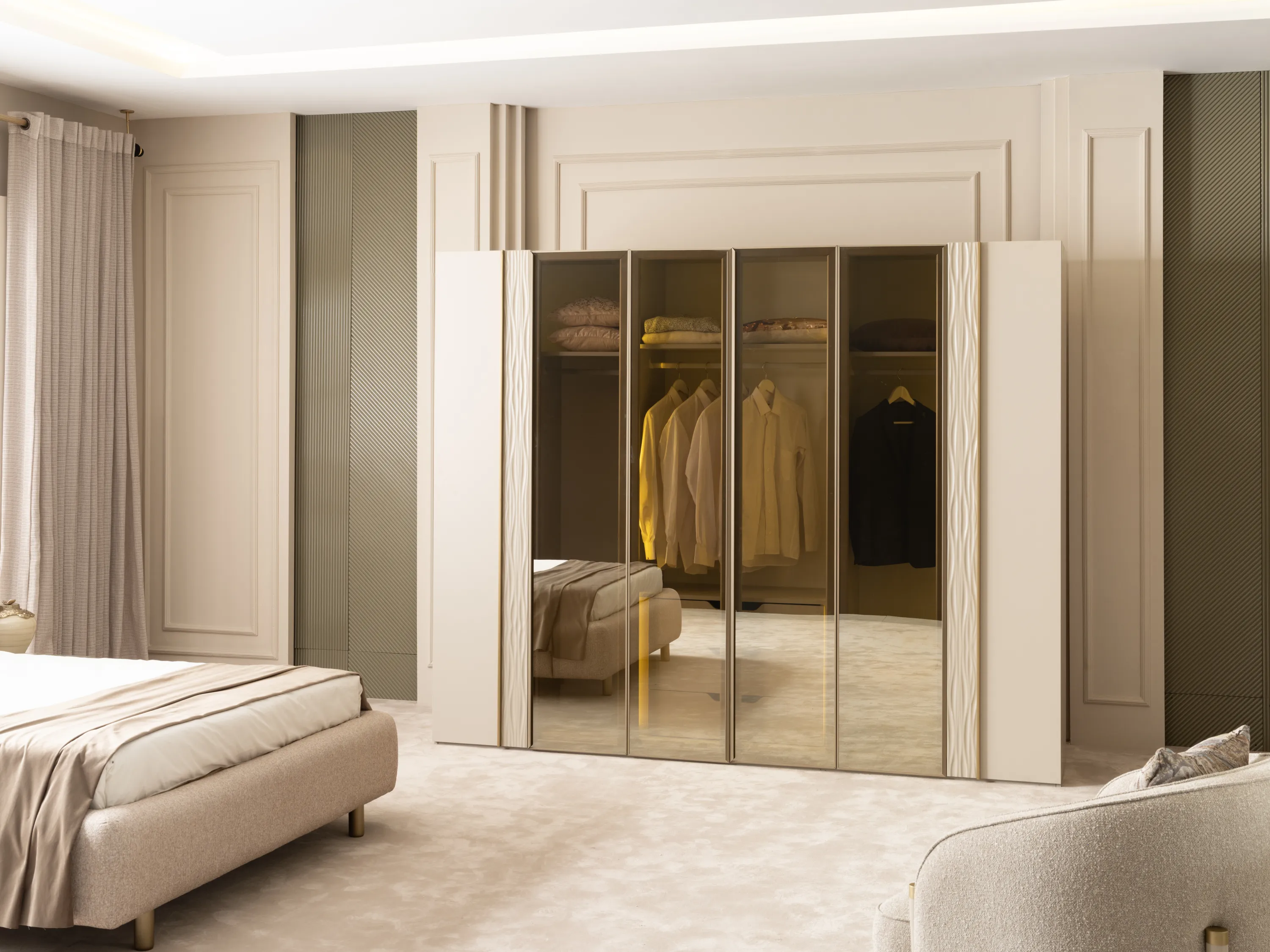
How Many Doors Should a Bedroom Wardrobe Have? Choosing by People and Room
Short answer: two things decide the number of doors: your needs set the floor, your wall sets the ceiling. For one person 2-3 doors, for a couple 4 doors, and for a couple who also store seasonal things in the wardrobe, 6 doors is enough. But if your wall is 240 cm, a 6-door will not fit whatever your needs. Find the number of doors you need from the number of people first, compare it with what your wall allows, and choose the smaller.
Wardrobe width and capacity by number of doors

A door is roughly 50 cm; multiply the number of doors by 50 and you get the wall it covers. Read the table through the usable hanging rail as well: that is the real measure of capacity, because part of every wardrobe goes to shelves and drawers.
| Doors | Wall covered | Typical hanging rail | Who is it enough for? |
|---|---|---|---|
| 2 doors | ~100 cm | ~90 cm | One person, a simple wardrobe or a second one |
| 3 doors | ~150 cm | ~140 cm | One person with plenty of clothes |
| 4 doors | ~200 cm | ~180 cm | A couple, shared across four seasons |
| 5 doors | ~250 cm | ~230 cm | A couple plus suitcases, duvets, bed linen |
| 6 doors | ~300 cm | ~280 cm | A couple plus seasonal overflow and suits |
↔ Scroll the table sideways to see all of it.
Body depth and how the modules join is a separate subject; we explained it in wardrobe dimensions and interior layout.
How many doors per person: the hanging-metre calculation
Measure rather than guess: lay out the clothes in your current wardrobe side by side without squashing them and read off the length with a tape. The rough proportions are:
- Shirts, blouses, T-shirts: 2-3 cm each on the rail.
- Dresses, jackets, suits: 4-5 cm.
- Coats, overcoats, parkas: 6-8 cm. Winter clothes are what really fill a wardrobe.
Add 25% breathing room to the length you find; clothes crease in a wardrobe packed tight. Example: if you have 120 cm of clothes, ask for 150 cm of rail — that means 3-4 doors. For two people, add the two lists together.
Do not forget the things that are not hung: jumpers, tracksuits, underwear, bed linen, suitcases. A practical measure is to allow a third of the wardrobe for shelves and drawers.
How many doors fit in how many m²?
Wall length alone is not enough. A hinged door reaches about 50 cm into the room as it opens, and you need allowance for the person standing in front of it. With sliding doors there is no such allowance.
| Room area | For hinged | For sliding |
|---|---|---|
| 9-11 m² | 2-3 doors | 4 doors |
| 12-14 m² | 4 doors | 4-6 doors |
| 15 m² and over | 6 doors | 6 doors and a corner module |
↔ Scroll the table sideways to see all of it.
Take the measurement above the skirting board and at three points along the wall; the method is in how to measure for furniture. If your room is narrow, look at the layouts in how to fit a bedroom set into a small room. If the wardrobe is going into a teenager's room, count in the wall needed for a desk too; the proportions are in teen room dimensions and choices.
Hinged or sliding?
This question matters as much as the number of doors; the two systems feel completely different on the same wall.
- Hinged doors: you see the whole wardrobe at once and choosing clothes is easy. In exchange it needs clear space in front. The Rams 4-door wardrobe is a handleless example of this arrangement.
- Sliding doors: the door slides sideways and never projects into the room. If there is less than 100 cm between the foot of the bed and the wardrobe, this is almost the only sensible choice. The cost: half the wardrobe is always closed, and if dust builds up in the track the door becomes stiff.
- Folding doors: the middle ground; the projection is halved and the front of the wardrobe still opens fully. Useful in a corner: the Rams corner wardrobe with mirror uses this arrangement.
The rule is simple: sliding in a narrow room, hinged in a roomy one. But on sliding doors the track quality is decisive; a door on a weak track sags within a few years.
Interior layout: how many of each module?

Once the number of doors is settled, divide the inside on this ratio:
- In a 4-door: two doors hanging, one door shelved, one door with drawers.
- In a 6-door: three doors hanging, two doors shelved, one door with drawers and a trouser rail.
A trouser rail is the omission people regret most; it hangs trousers without folding them and reduces the need to iron. What each module does is in our interior layout article. If you are considering mirrored doors, bedroom sets with glass covers the care side.
Ceiling height and the space above the wardrobe
Standard wardrobes do not reach the ceiling; 20-40 cm is left above. Either have an upper module added to that space, or use it for suitcases and seasonal boxes. If you are buying an upper module, tell us your ceiling height before ordering; with a low ceiling the real risk is not being able to stand the wardrobe up in place.
Six things to check when buying
- Hinges: soft-close hinges should be standard.
- Runners: ask for full extension on drawers; on sliding doors, a double top-and-bottom track lasts longer than a single one.
- Back panel: a thin back panel lets the wardrobe go out of square over time; choose a thick one seated into a groove in the body.
- Wall fixing: tall bodies can topple; make sure the top is fixed to the wall during installation. In a home with children this is a safety matter.
- Mirror weight: a mirrored door adds load to the hinges; check whether a third hinge has been used.
- Doors and lifts: modules pass through most flat doors; single-piece wide bodies do not.
To compare models see the bedroom wardrobe models and bedroom sets pages. Whether the wardrobe is included in the set is a separate matter; how to read the count is in how many pieces are in a bedroom set.
Frequently Asked Questions
What size room does a 6-door bedroom set suit?
It needs about 300 cm of uninterrupted wall, which usually means a room of 15 m² or more. With hinged doors you also need 90-100 cm clear in front of the wardrobe.
How many doors are enough for one person?
2-3 doors is enough in most cases. Go to 3 doors for someone with a lot of winter clothes; 4 doors is generally too much for one person.
What happens if the wardrobe depth is 50 cm?
Shoulder width on a hanger does not fit comfortably in 50 cm, so clothes sit at an angle and rub on the door. That is why around 60 cm depth is standard.
What is a narrow module for in a modular wardrobe?
It fills the space left over when your wall length does not divide evenly. On a 250 cm wall, a single-door module is added beside two double-door modules and the wall is fully covered.