Bed Size Chart: Every Standard Size from Cot to King
Short answer: a three-quarter ("one and a half person") bed is 120×200 cm. A single bed is 90×190 or 100×200 cm, a double 150×200 cm, and the most-chosen wide size 160×200 cm. 180×200 and 200×200 cm are known as king size. The size is always written width × length. The external size of the bed frame is far above these figures; when planning the room, work from the size of the frame, not the mattress.
Bed size table: which size sleeps how many?
| Size (width × length) | Name | How many | Who it is for |
|---|---|---|---|
| 70×130 cm | Cot mattress | 1 | 0-3 years, cot with bars |
| 80×180 cm | Child's bed | 1 | 3-8 years, low frame |
| 90×190 cm | Single | 1 | The most common single size |
| 100×200 cm | Wide single | 1 | Tall teenagers and adults |
| 120×200 cm | Three-quarter (one and a half) | 1 in comfort | One person + plenty of room to turn |
| 140×190 / 140×200 cm | Small double | 2 | Small bedrooms |
| 150×200 cm | Standard double | 2 | The classic double size |
| 160×200 cm | Wide double | 2 | The most-chosen comfort size |
| 180×200 cm | King size | 2 | Large rooms, those who sleep with a child |
| 200×200 cm | Super king | 2 | Bedrooms over 20 m² |
↔ Scroll the table sideways to see all of it.
If you want the width per person: 75 cm on a 150 bed, 80 cm on a 160, 90 cm on a 180. For comparison, a train seat is 45-50 cm wide and a sofa seat 55-60 cm.
How many cm is a three-quarter bed, and who is it for?

A three-quarter bed is 120×200 cm. Some makers also produce it 190 cm long, but the common standard is 120×200. The name is misleading: it is not a size two people can sleep on comfortably. It is a bed for one person who sleeps spread out and turns a lot, or for an adult sharing temporarily with a small child. For two adults the lower limit is 150×200.
A three-quarter bed makes sense in these cases:
- In a teenager's room, for secondary-school and university-age young people who find a 90 bed narrow
- In single bedrooms of 10-12 m², where a 150 bed would eat the circulation space
- In guest rooms — roomy for one, workable for two
- For those who sleep alone but work, read or sleep with a pet in bed
The storage base for a three-quarter bed is also 120×200 cm; the base always goes under the mattress at exactly the same size. On storage bases the body height is 33-40 cm, and with a 22-32 cm mattress on top the total sitting height reaches 55-70 cm.
One thing to watch: ready-made bed linen is harder to find for 120×200 than for 150 and 160. Think about the textile side before buying.
Frame size and mattress size are not the same thing
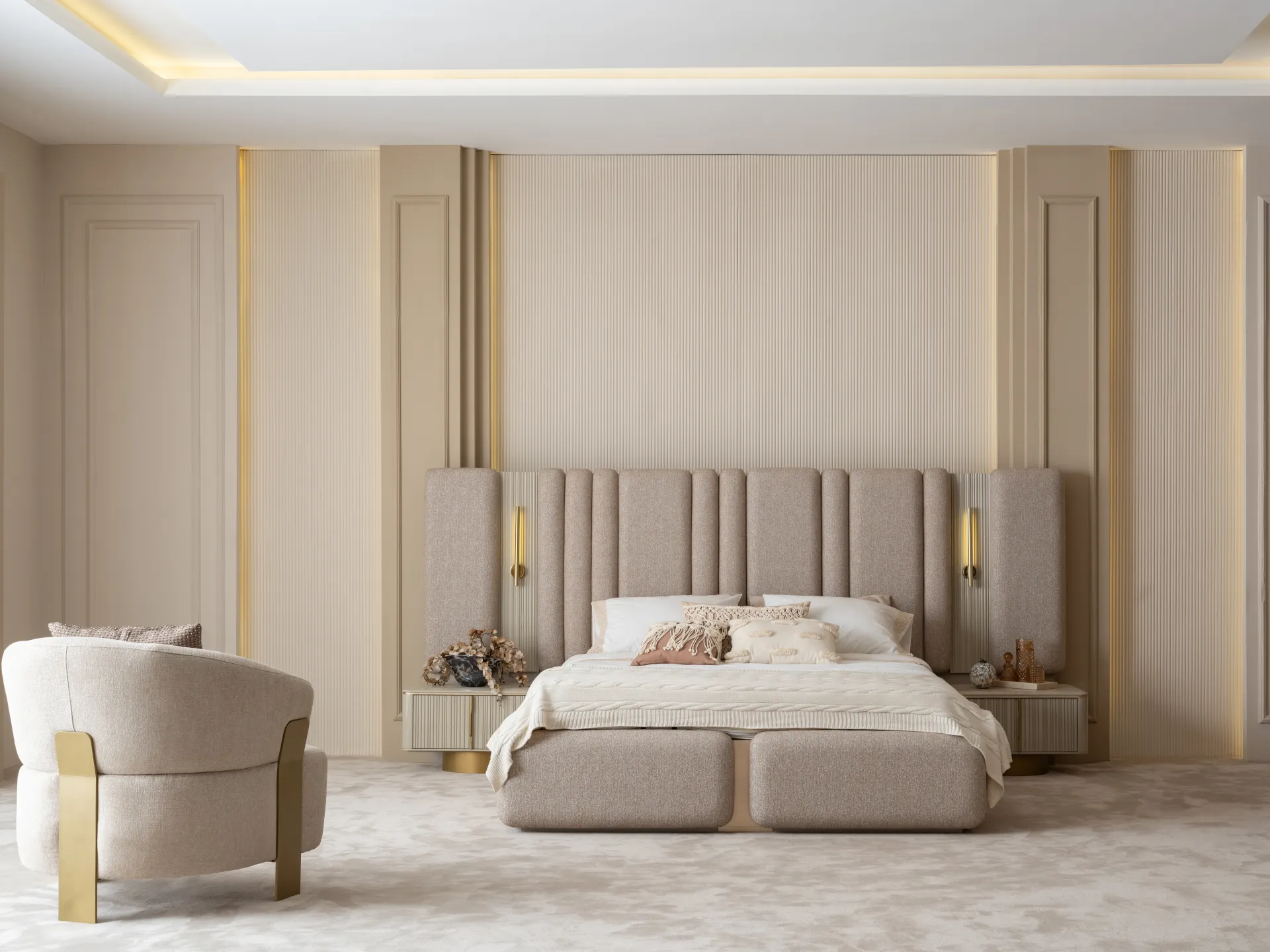
This is the most common mistake when planning a room. The bed size is the size of the mattress you sleep on. The frame is the body that surrounds the mattress; the headboard, side panels and base wall are added on top of that. The difference can be 40 cm or 150 cm.
The figures below are the external dimensions of real Selishome models, all for a 160×200 cm mattress:
| Bed frame | External width | External length | Headboard height |
|---|---|---|---|
| Plain headboard model | 200 cm | 243 cm | 110 cm |
| Medium panelled | 215-220 cm | 225-236 cm | 96-130 cm |
| Wide panelled | 240-250 cm | 230-240 cm | 97-105 cm |
| Panelled with built-in bedside tables | 310 cm | 225 cm | 142 cm |
↔ Scroll the table sideways to see all of it.
The conclusion is clear: the answer to "will a 160 bed fit my room?" is not 160 but a wall allowance somewhere between 200 and 310 cm. When the panels extending on either side of the headboard act as bedside tables, you do not need to find separate space for them; with a plain-headboard model you have to add another 130-140 cm beside the 200 cm for two bedside tables.
The external length of 225-243 cm matters too: the thickness of the headboard and the footboard panel are added to the 200 cm mattress. When working out the room's depth, write 240 cm, not 200.
If you are after a plain body with no headboard, models such as the Rams bed frame without a base give the external size closest to the mattress size. For the dimensions of the other pieces in the set, see standard bedroom set dimensions.
Base height and mattress thickness

A bed size is not only width and length; the third dimension, thickness, directly decides comfort.
- Mattress thickness: 22-32 cm is normal for sprung and memory-foam mattresses. On mattresses over 30 cm, watch the size of fitted sheets.
- Base height: 33-40 cm is common on storage bases.
- Total sitting height: getting out of bed is easiest when base + mattress comes to 55-65 cm. Over 70 cm is hard for shorter people and the elderly.
- The base's external size equals the mattress size. The base for a 150×200 mattress is also 150×200; what creates the difference is the frame.
To decide whether you want to use the space under the bed for storage, our comparison storage bed or normal bed will help.
How to choose a bed size for a child's or teenager's room
- After age 7, buy 90×190. An 80×180 child's bed becomes too small in 3-4 years; buying a second bed costs more than choosing one size up from the start.
- If they will be taller than 175 cm, choose a 200 cm long mattress. On a 190 cm mattress an 180 cm teenager sleeps with their feet at the edge. The practical rule: mattress length = the person's height + 15 cm.
- 120×200 is the ideal middle ground for a teenager's room. Clearly wider than 90 and 30 cm narrower than 150; in rooms under 12 m² it leaves space for a desk.
- Leave at least 60 cm of passage along the long side of the bed. The desk and the wardrobe door's opening allowance share this space.
To plan the whole room, see our guide to teen room dimensions and choices.
How do you measure for a mattress?
- If you are measuring an existing mattress, take the sheet off and measure the mattress itself — bedding and a protector throw you off by 2-4 cm.
- Take the frame's internal measurement: the clear distance between the side panels and between the head and foot panels. The new mattress has to go inside those two figures.
- Measure at three points: head, middle and foot. On older frames the panels may have bowed inwards; go by the smallest.
- Do not forget the thickness. If the frame's side panel is 25 cm high, a 32 cm mattress stands 7 cm above it and the look suffers.
- Test whether it fits the room with a sketch. Measure the walls one by one; do not round to "the room is 3×4".
We explained how to use a tape properly and measure the routes in how to measure for furniture.
Which size fits your room?
Once the bed is in place, leave 60 cm of passage on at least one long side, and if possible 60 cm on both. There must be 90 cm of clear space in front of the wardrobe for the doors to open.
| Room area | Recommended mattress size |
|---|---|
| 7-9 m² | 90×190 or 120×200 (single use) |
| 9-11 m² | 140×190 or 150×200 |
| 12-14 m² | 150×200 or 160×200 |
| 15-18 m² | 160×200 comfortably, 180×200 possible |
| 18 m² and over | 180×200 / 200×200 |
↔ Scroll the table sideways to see all of it.
We worked out how many square metres your room should be in how many m² a bedroom should be; and you can see how much wall a wardrobe eats in standard wardrobe dimensions.
In Selishome bedroom sets the standard bed takes a 160×200 cm mattress; depending on the model, 180×200 and 200×200 are also offered. You can compare models in the bed frame category or in the bedroom sets section.
Frequently asked questions
How many cm is a three-quarter bed?
120×200 cm. Some makers produce it 190 cm long, but the common standard is 120×200. "One and a half person", "three-quarter" and "1.5" all describe the same size.
Is a three-quarter bed enough for two?
No. At 120 cm wide each person gets 60 cm, the width of a train seat. For two adults the lower limit is 150×200 and the comfortable size is 160×200. 120×200 is for one person sleeping spread out, or an adult sharing temporarily with a small child.
How many cm is a three-quarter storage base?
120×200 cm. A base is always made exactly the same width and length as the mattress. On storage bases the body height is 33-40 cm.
How many does a 150×200 bed sleep?
Two. It is the classic double size in Turkey and gives 75 cm per person. 160×200 is the "wide double" and gives 80 cm each.
Should I buy 150×200 or 160×200?
If two people will sleep in it and your room is over 12 m², 160×200 is noticeably more comfortable. If the room is tight, choose 150×200; the 10 cm you lose matters less than the circulation space you gain.
How much bigger is the frame than the mattress?
For a 160×200 mattress the external width of the frame is 200-310 cm depending on the model, and the external length 225-243 cm. The difference comes from the headboard panel and the footboard. In your room plan, use the frame's size, not the mattress's.
How many cm are queen and king size in Turkey?
International sizes are not used exactly as they are in Turkey. Here, 160×200 is often sold as "queen" and 180×200 and above as "king size". Do not overlook this difference when buying imported bedding.
How do you match the mattress size to the bedding?
For fitted sheets, check the mattress thickness as well as the size. A sheet for a 160×200 mattress is written 160×200+30 cm; on a 32 cm thick mattress that sheet will slip off the corners.
Does changing the mattress size mean changing the frame?
Yes. A frame is made for a particular mattress size; a 160 mattress will not go into a 150 frame. Before choosing a mattress, measure the internal size of your existing frame with a tape — do not trust remembered dimensions.