What Is an Armchair, and How Do You Choose One? Dimensions and Uses
Short answer: an armchair is a single-seat chair with arms and a high back. In the classic definition there are "wings" on either side of the back, but today "armchair" usually means the single piece in a sofa set. The width is mostly 80-90 cm, the depth 75-95 cm and the back height 90-110 cm. What sets an armchair apart from other single chairs is not its size but its function: it is designed for sitting a long time, for reading, for joining the conversation.
What is an armchair, and how does it differ from a single chair?
The word comes from the French bergère and describes a single-seat chair with padded arms and a high back. In everyday Turkish "single chair" and "armchair" are used interchangeably, but there are practical differences:
| Armchair | Occasional chair | Pouffe | |
|---|---|---|---|
| Arms | Yes, padded | None or hard | None |
| Back height | 90-110 cm, above the shoulder | Between waist and shoulder | No back |
| Length of use | Long sittings | Short sittings | Feet / extra seat |
| Space taken | Medium | Little | Least |
↔ Scroll the table sideways to see all of it.
So an armchair builds both seating capacity and a "corner" in the living room. The "1" in a 3+2+1 sofa set is usually the armchair.
Where is an armchair used?
- Completing a set in the living room: placed at an angle to the three- and two-seaters, it creates a face-to-face conversation layout.
- A reading corner by a window: add a small side table and a floor lamp and it becomes the most used spot in the room.
- A dressing corner in the bedroom: at the foot of the bed or opposite the dressing table.
- In an entrance hall or wide corridor: it makes an empty wall useful.
- Instead of a two-seater in a small room: two armchairs take less space than a two-seater and make the layout more flexible.
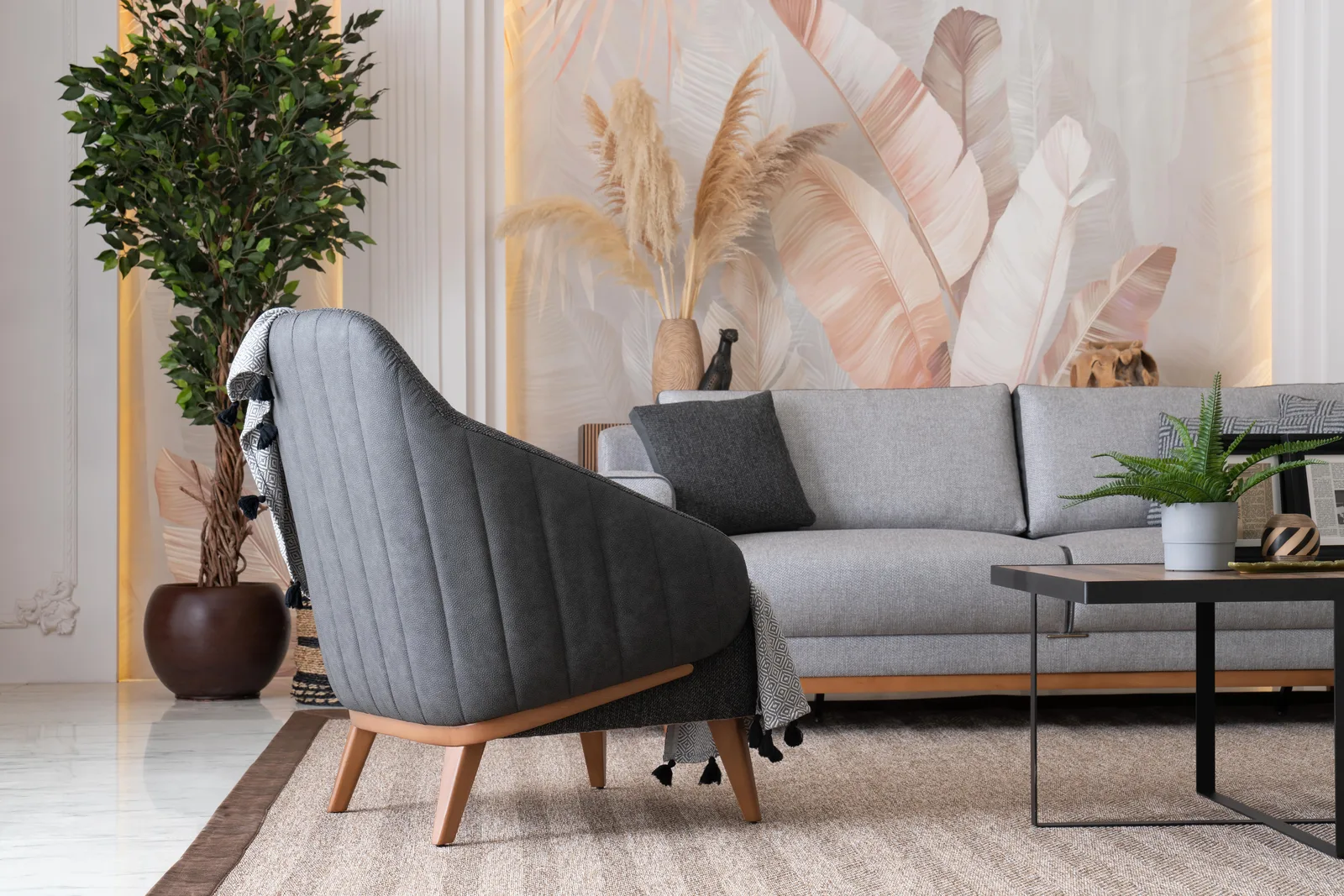
As an example, the Yomra Armchair combines a retro line with a plain form through its dark timber frame and open sides; it can be used as a reading chair by a window or as a dressing corner in a bedroom.
Armchair dimensions: how many cm?

| Dimension | Common range | What it means |
|---|---|---|
| Width | 80-90 cm | Outer size including the arms |
| Depth | 75-95 cm | 95 cm and over gives a "sink into it" seat |
| Back height | 90-110 cm | Over 100 cm gives head support |
| Seat height | 42-48 cm | The easiest range to get up from |
| Seat depth | 50-60 cm | Over 60 cm leaves shorter people sitting upright |
↔ Scroll the table sideways to see all of it.
Leave at least 60 cm of circulation space around an armchair; add another 40 cm in front if you will use a footstool. When planning the whole room, the wall allowance rules in our article on sofa set dimensions and living room layout will help.
What to look for when choosing an armchair
- Frame: a solid hornbeam or beech frame does not move when you lean on the arms. On an armchair, the arm is the most tested part.
- Foam density: a seat in the 28-35 density range holds its shape for years. A single-seat chair is loaded at the same spot every day; low density collapses quickly.
- Back height: if you will sit for long periods, choose high-backed, winged models that support your head.
- Seat height: below 42 cm is hard to rise from, over 50 cm leaves your feet dangling.
- Leg type: visible slim metal or wooden legs give a light look in small rooms. Models with a closed skirt look heavier.
- Fabric: an armchair is usually the accent piece in a room; it can be chosen in a different colour or pattern from the set. We explained the rules of matching in how to choose sofa fabric.
Should the armchair match the sofa set?
Not necessarily — and often it is better if it does not. There are three common approaches:
- Same fabric, same model: the safest choice. The unity of the set is preserved and the room looks calm.
- Same fabric family, different tone: if the sofas are beige, the armchair in cinnamon or khaki. It adds depth to the room.
- A contrasting armchair: a single piece in a pattern or an entirely different texture. It creates a strong focus in small rooms, but left on its own it can look patched on; repeat the same colour in a cushion or a detail on the table.
If you struggle to match colours, the 60-30-10 rule in our article on how to match furniture colours will help directly.
If you are choosing the whole set from scratch, we set out the order in which to make the arrangement, size, fabric and frame decisions in our guide on how to choose a living room set.
The armchair, pouffe and table trio

Putting an armchair alone in a corner is not enough; to build a usable corner you need two more things beside it:
- A footstool: it makes long reading sessions comfortable and becomes an extra seat when guests come. Round models that can be carried with one hand, such as the Bergama Pouffe, are practical for this.
- A side table: a top at 45-55 cm high, close to the armchair's armrest level.
- Directional light: a floor lamp or wall light rather than the ceiling fitting, for reading.
You can see armchairs and complementary pieces in the armchair category, and the whole seating group in the living room category.
Frequently asked questions
How wide is an armchair?
The common range is 80-90 cm. An armchair 80 cm wide sits comfortably in small rooms; models of 90 cm and over give a wider seat but increase the wall allowance needed.
Is it called an armchair or a single chair?
Both are used. Technically an armchair is a single-seat chair with arms and a high back; in the trade the single piece in a sofa set is generally called an armchair.
Does an armchair take up space in a small living room?
It takes less space than a two-seater. In small rooms, using two armchairs instead of a two-seater both eases the walkway and makes the seating arrangement more flexible.
Can an armchair be bought on its own?
Yes. An armchair is usually offered as part of a set but can also be bought singly. If you are adding one to an existing set, make sure the seat height is close to your set's; a difference of more than 5 cm spoils the seating arrangement.
We compared the advantages and risks of buying piece by piece rather than as a set in our article on buying furniture piece by piece or as a set.
Can an armchair go in a bedroom?
It can. It is used at the foot of the bed or by a window, for sitting while dressing and for reading. In that case choose models with a 45-48 cm seat height that are easy to rise from, rather than deep, low ones.