8-Seater Table Sizes: Rectangular, Round, Oval and Extending
Short answer: A dining table for 8 people is 200-220 × 90-100 cm if rectangular, 150-160 cm in diameter if round, and 210-220 × 100-110 cm if oval. The height is 75-78 cm in every shape. With extending tables the calculation changes: a table that is 180 × 100 cm when closed reaches 260 cm when opened and seats 8 people comfortably and 10 tightly. In other words, an "8-seater table" is not a single size but the 60 cm of table edge per person rule as it works out for each shape.
8-seater table sizes: chart by shape
| Shape | Comfortable size | Tight minimum | Seating layout |
|---|---|---|---|
| Rectangular | 220 × 100 cm | 200 × 90 cm | 3 on each long side, 1 at each end |
| Square | 180 × 180 cm | 160 × 160 cm | 2 on each side |
| Round | 160 cm diameter | 150 cm diameter | 8 evenly spaced around the edge |
| Oval | 220 × 110 cm | 210 × 100 cm | 3 on each long side, 1 at each end |
↔ Scroll the table sideways to see all of it.
The "tight minimum" column in the table is the size at which everyone can sit but elbows touch. This is no problem for short-lived crowds such as a holiday feast; if 8 people sit down every evening, go by the comfortable column.
Where does the calculation come from? The 60 cm per person rule
The width of edge one person needs for a plate, a glass and cutlery is 60 cm. This measurement comes not from the width of the chair but from shoulder width and arm movement. You can go down to 55 cm, but below that two people begin to share the same plate space.
On a rectangular table the calculation works like this: if 3 people sit on each long side, you need 3 × 60 = 180 cm of net edge. If a leg is at the corner, add an allowance of 10-20 cm to this, which makes 200 cm. If you are going to seat one person at each end, the depth of the table should be at least 90 cm; at a depth of 80 cm the person at the end sits at the corner, not at the table.
On a round table the calculation runs on the circumference: diameter × 3.14 ÷ 60 = number of people. At 150 cm diameter the circumference is 471 cm, which gives exactly 8 people. The same formula makes 8 people comfortable at 160 cm diameter.
8-seater rectangular table: 200 or 220?
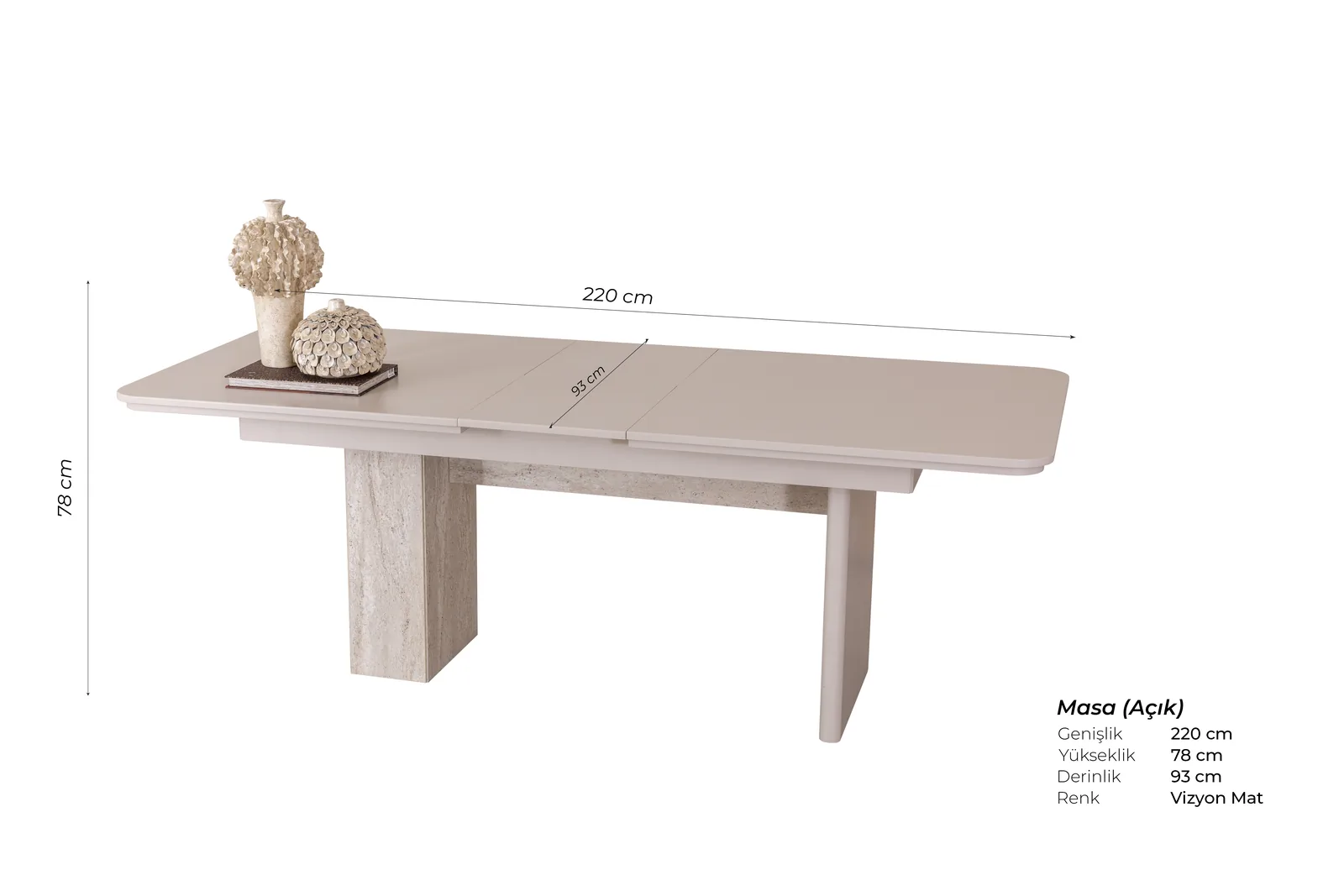
The 20 cm between them is the only difference felt in daily use:
- 200 × 90 cm: 8 people sit, but serving dishes do not fit in the middle of the table. A pot or salad bowl placed in the middle eats into people's plate space.
- 200 × 100 cm: Because the depth increases by 10 cm, a serving strip of 30-35 cm is left in the middle. This is the most balanced size for a table of eight.
- 220 × 100 cm: Adds 20 cm of comfort per side. If your room allows, buying the 8-seater table in this size also saves you with 10 people on busy days.
We do not recommend a depth beyond 100 cm: on tops of 110 cm and more you have to stand up to pass the salt to the person opposite. How the top material behaves at these sizes is a separate subject; we compared ceramic, porcelain and marble in table top materials.
8-seater round and oval table sizes
A round table approaches its limit at 8 people. At 150-160 cm in diameter everyone sits, but the area in the middle of the table becomes a "dead zone" that nobody can easily reach. It is no problem if you serve from the edge or use a rotating serving tray.
The practical solution is tables that are round when closed and become oval when opened. For example, the 130 cm diameter version of the Capi extending round table extends to 226 cm by adding 48 cm on each side; in daily life a round table for 4-6 people, with guests an oval table for 8. The biggest advantage of a round table is that it has no corners: in narrow passages shoulders do not brush, and there is no fight over the head of the table.
An oval table is a rectangle with softened ends. A 220 × 110 cm oval table looks as though it takes up less room than a rectangle of the same size, but because the edge width narrows at the ends, the two people at the head have slightly less space.
Being an 8-seater with an extending table
In small and medium living rooms the smartest solution is an extending table instead of a fixed 220 cm one. With real examples:
| Closed size | Open size | When closed | When open |
|---|---|---|---|
| 180 × 100 cm | 220 cm | 6 people | 8 people |
| 180 × 100 cm | 260 cm | 6 people | 10 people |
| 200 × 100 cm | 290 cm | 8 people | 12 people |
↔ Scroll the table sideways to see all of it.
The first row is the classic single-leaf mechanism; the table of the Grande dining room works in this setup. The second and third rows are the two size options of the Tesla extending dining table. For homes that like to lay a long table, there are also models that extend to 500 cm; the Royal extending dining table is an example.
Note: The open size always grows into the room. If, with the table open, there is no allowance on each occupied side for the chair to be pulled back, that table is not in practice an 8-seater. We went into the mechanism types and planning by open size in our extending dining table guide.
How many m² should the room be for an 8-seater table?
To the table's own size you add 90 cm on every side that is sat at. This allowance is for pulling the chair back (75 cm) and walking behind it (an extra 15-20 cm).
- 200 × 100 cm table: needs 380 × 280 cm of net area, so roughly 10.6 m²
- 220 × 100 cm table: 400 × 280 cm, so roughly 11.2 m²
- 160 cm diameter round: 340 × 340 cm, so roughly 11.5 m²
This area is the dining section only; if you share the living room with a seating group, set this allowance aside from the total square metres and leave the rest to the sofas. We explained with sketches which distances to keep when dividing a living room in two in our article on living room layout plans. If one side is against a wall, you can drop the 90 cm allowance for that side, but then the table becomes a 6-seater, not an 8.
Choosing chairs: will 8 chairs fit the table?
Getting the size calculation right and choosing the chair wrong is the most common mistake. Look at three numbers:
- Chair width 45-50 cm. 3 chairs fit comfortably along a 220 cm side; on a 200 cm side, wide 50 cm chairs rub against each other.
- Clear space under the top at least 62 cm. On tables with an apron and a thick top this measurement drops, and a tall user's knee hits the apron.
- Height of the armrest should not exceed 68-70 cm. If it does, the chair cannot go under the table and the passage around the table narrows.
We gathered the criteria beyond size, such as fabric, leg type and ease of care, in how to choose dining room chairs; you can compare models in the chair category and tables in the table category.
Frequently Asked Questions
What is the size of an 8-seater table in cm?
200-220 × 90-100 cm for rectangular, 150-160 cm diameter for round, 210-220 × 100-110 cm for oval. The height is 75-78 cm in every case.
How many people does a 200x100 table seat?
Eight. 3 people sit on each long side and 1 at each end. The 60 cm per side allowance is met exactly at this size, and a strip of about 30 cm is left in the middle for serving.
What size should an 8-seater round table be?
150 cm diameter is the minimum and 160 cm the comfortable size. Going beyond 160 cm does not increase capacity; it only enlarges the unreachable area in the middle.
Can a 6-seater table become an 8-seater?
Not a fixed table; if 8 people sit at a 180 cm top, it works out at 45 cm per person. An extending table can: when the 180 cm closed size reaches 220-260 cm, 8 people sit comfortably. For all the 6-seater sizes, see our article on 6-seater table sizes.
How many square metres should the room be for an 8-seater table?
10.5-11.5 m² is needed for the dining section alone. If there is also a seating group in the living room, take this allowance off the total area and give the rest to the sofa layout.
How many chairs come with an 8-seater table?
Dining room sets sold as a suite usually come with 6 chairs; even if the table capacity is 8, the number of chairs is separate. You can order the remaining two chairs from the same series as an extra. We tabulated the relationship between the number of people and the number of pieces in dining table sizes.