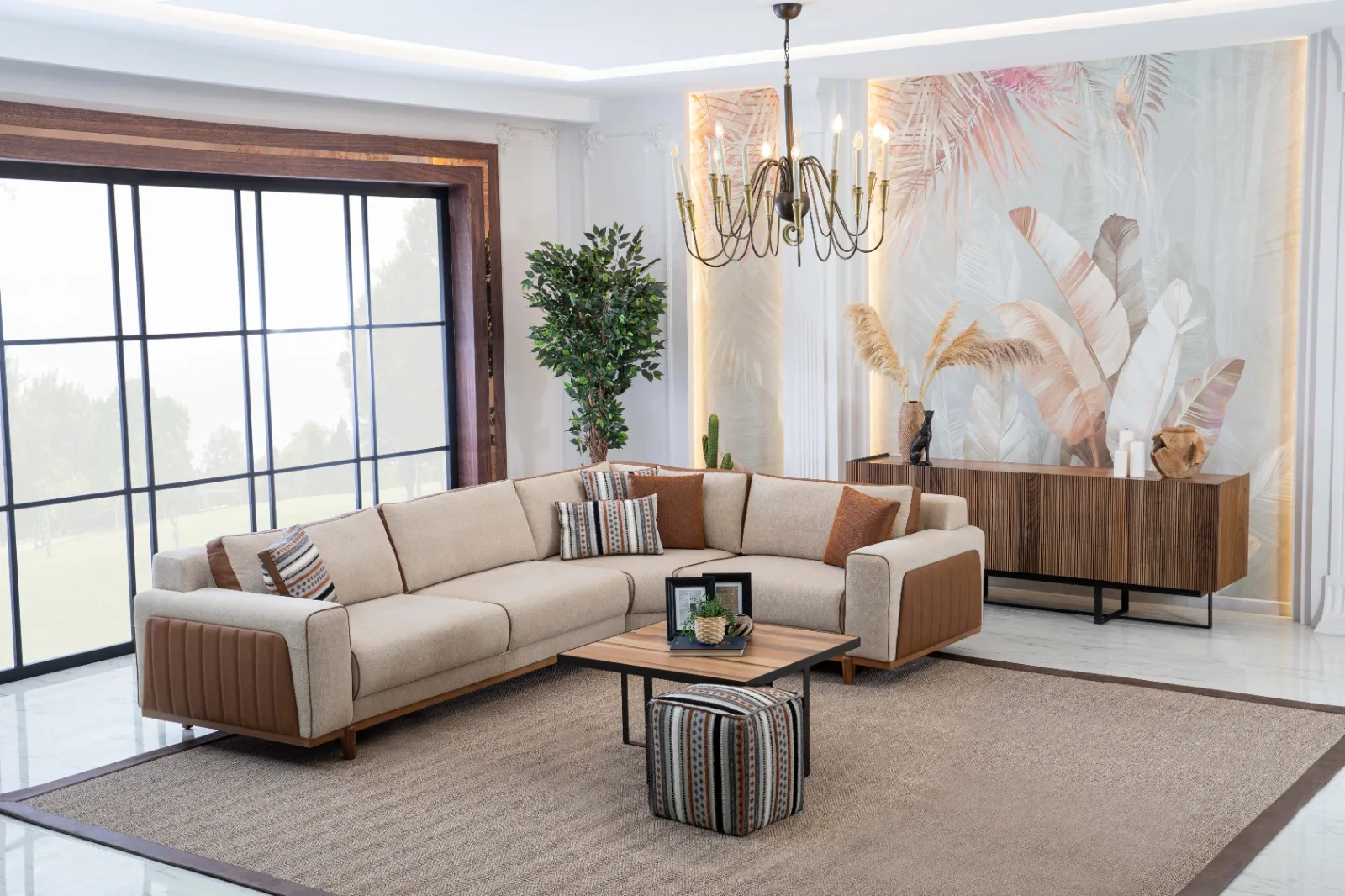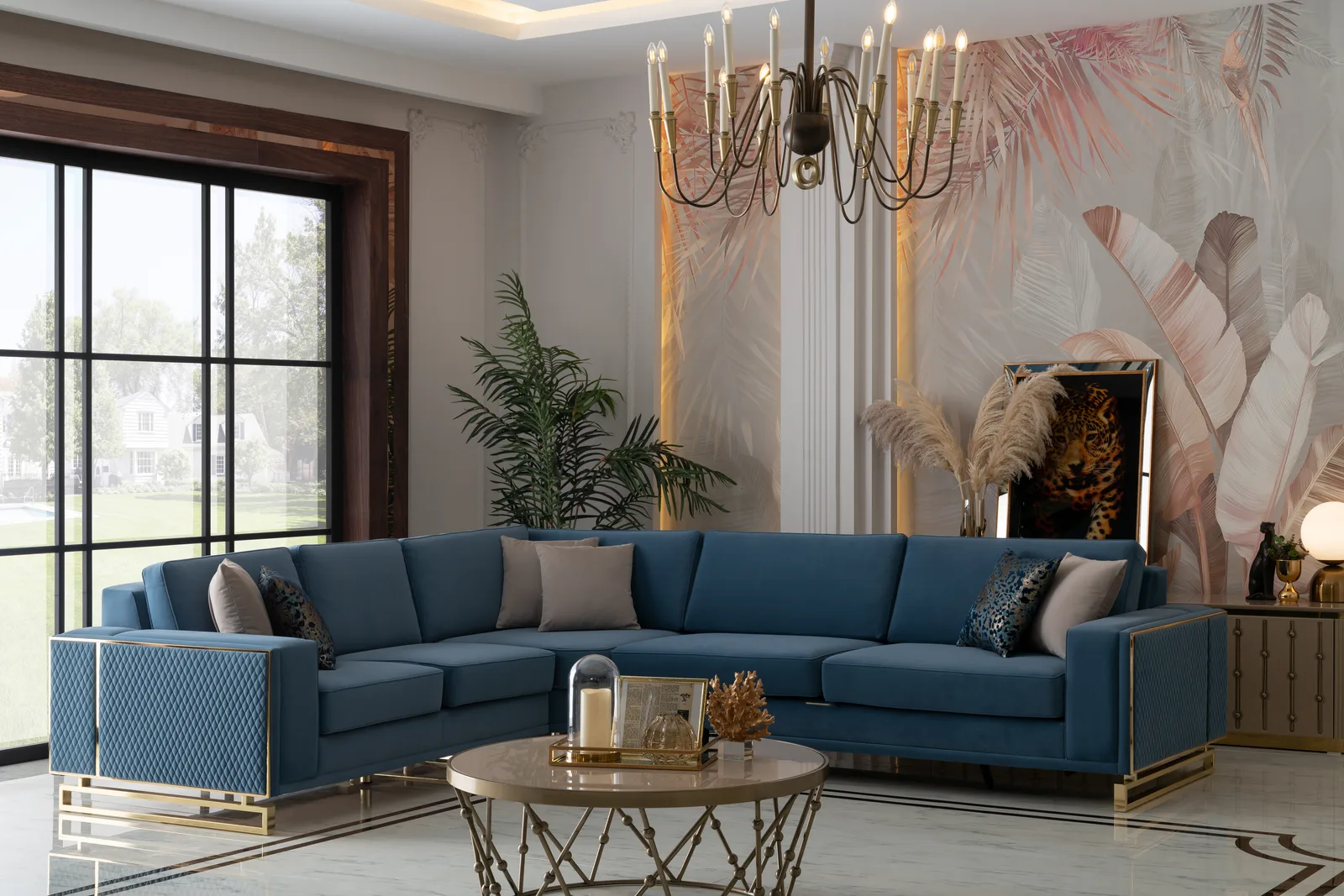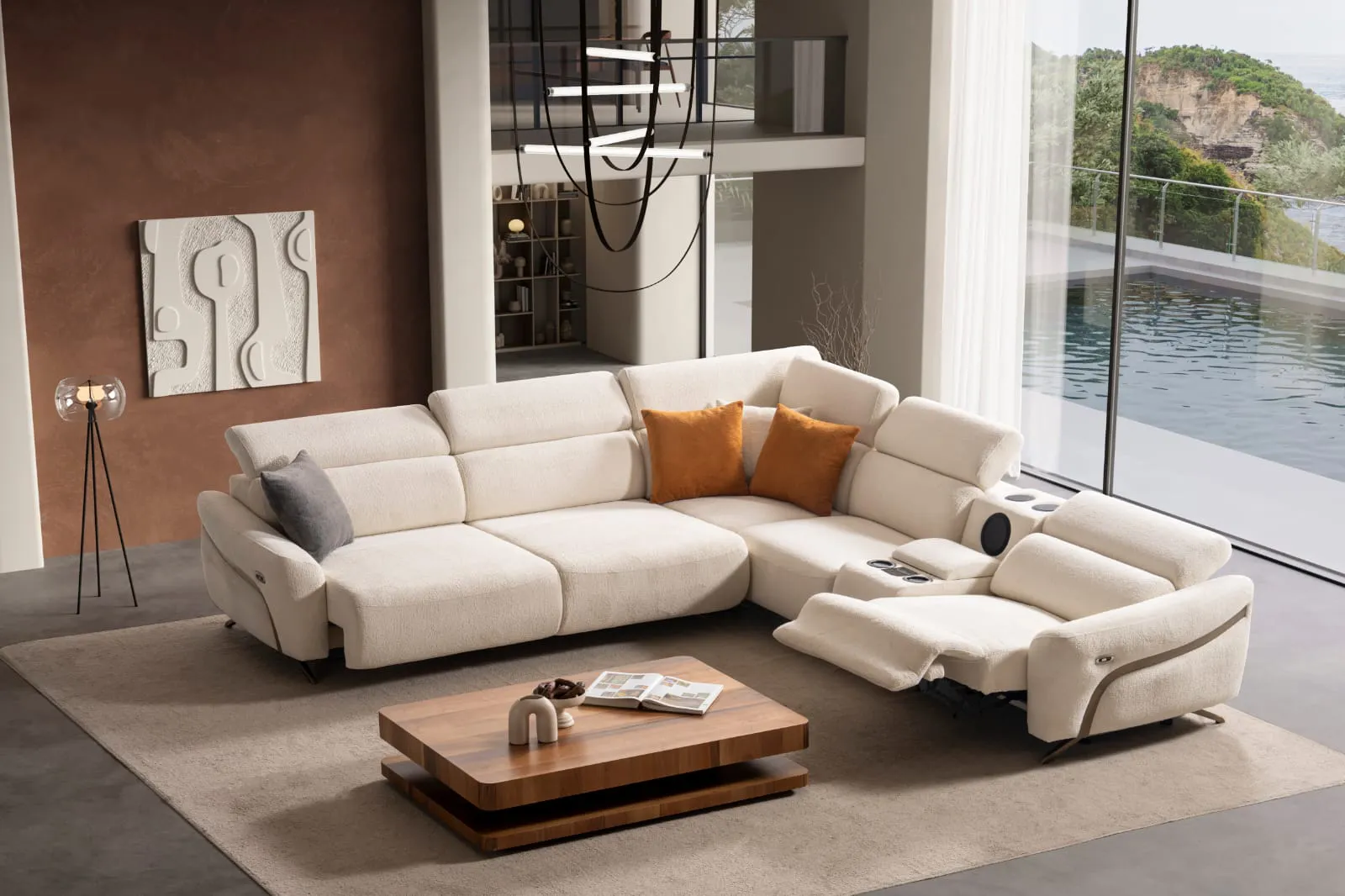
What Is a Chaise Longue? What It Does on a Corner Sofa, and Who It Suits
Short answer: a chaise longue is the reclining section of a corner sofa, far deeper than normal, on which you can sit with your legs stretched out. In Turkish it is called a "reclining module" or "relax module"; the French means "long chair". While an ordinary seating module is 100-110 cm deep, a chaise longue module goes to 160-170 cm. That is exactly the difference.
What does chaise longue mean, and what is it for on a corner sofa?
On a classic sofa your knees bend and your feet reach the floor. On a chaise longue section you stretch your legs out fully: without buying a separate chaise or pouffe, you carry a small reclining area within the sofa.
That section is usually the short wing of the L. Note: not every L sofa has a chaise longue. If the short wing is also 100 cm deep, that is not a reclining section but ordinary seating. It is the depth that defines a chaise longue.
Corner sofa, L sofa, chaise longue and daybed
| Term | Distinguishing feature | Depth |
|---|---|---|
| Corner sofa | Wings joined by a corner module, set against the wall | 100-120 cm |
| L sofa | The shape name for a corner sofa, the same product | 100-120 cm |
| Chaise longue | Reclining module, back on one side only, deep | 160-170 cm |
| Daybed | Not part of the sofa, a separate piece of furniture | 80-100 cm |
↔ Scroll the table sideways to see all of it.
Chaise longue dimensions: what to look at
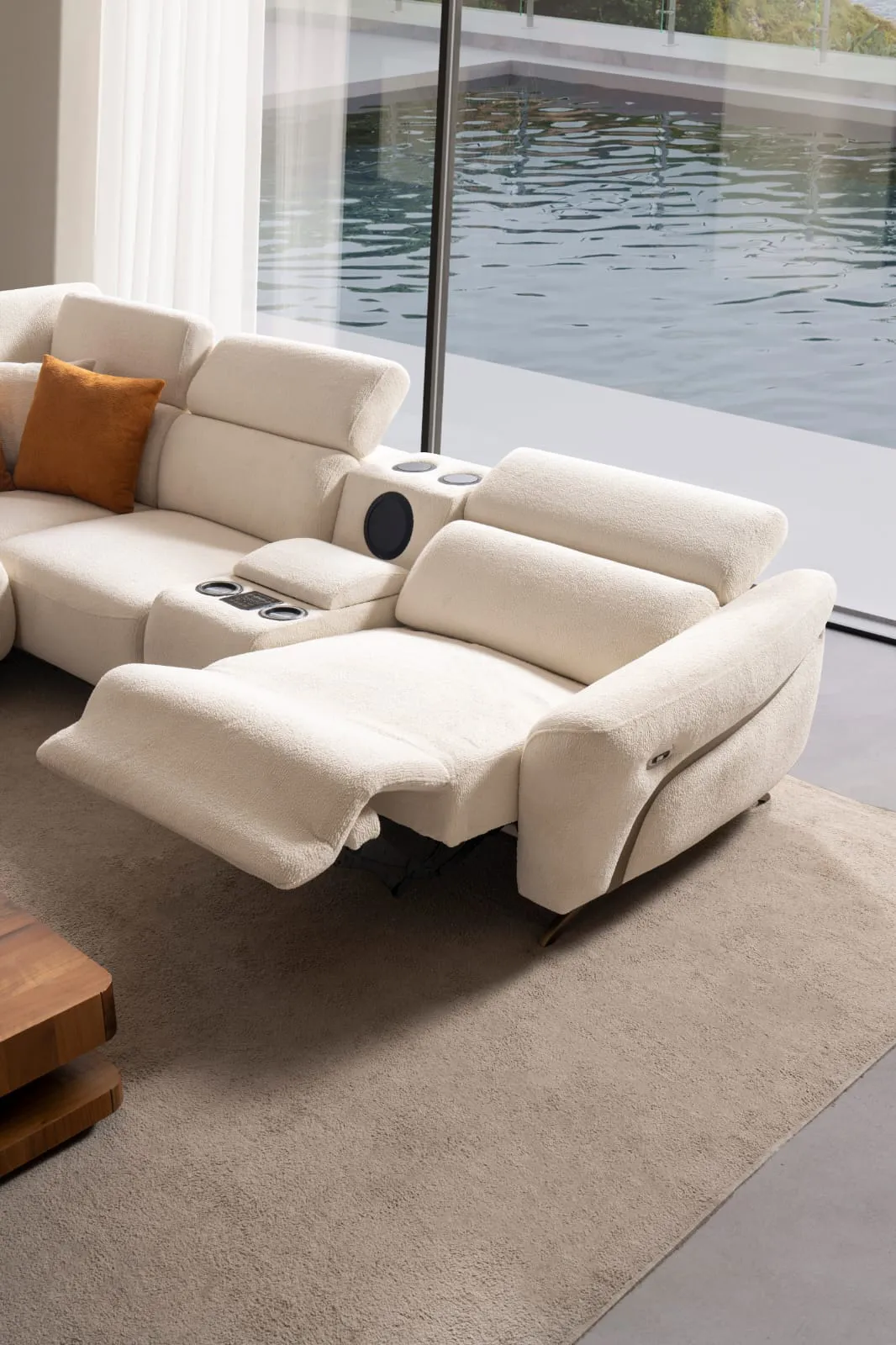
- Depth (the most critical measurement): below 160 cm an adult of average height cannot stretch their legs out fully. The 170 cm right- and left-arm modules of the Kays corner sofa set are 120 cm wide × 170 cm deep, while the standard modules of the same set are 100 cm deep. Those 70 cm are the reclining area.
- Width: 100-120 cm is enough; any narrower and your shoulder touches the armrest.
- Height: 72-90 cm depending on the model. The higher the back, the more your head is supported and the more generous the sofa looks.
When working out the total length, add the modules one by one. In the Tesla corner sofa, for example, a 200 cm reclining module, a 110 cm corner module, a 100 cm TV module, an 80 cm pawn and a 40 cm music module come together. Do not rely on descriptions like "3+2". Dimension tables: sofa set dimensions and living room layout.
Right or left chaise? A step-by-step decision

This is the most common mistake and it is hard to undo after ordering. Work through it in this order:
- 1. Stand at the door of the room. Look in as if entering and picture the wall the sofa will go against.
- 2. Put the chaise away from the window. The chaise does not sit against a wall; it reaches into the room. If it blocks a window or balcony door it cuts the light and blocks the way.
- 3. Protect the walkway. Think about the route you walk from the living room to the kitchen; if the chaise falls on that line you will walk round it every day. The side furthest from the door is right.
- 4. Check the television. When you lie back, can you see the screen without turning your neck? The chaise should not be at right angles to the screen.
- 5. Note the radiator and sockets. If the chaise blocks the radiator, the room heats up slowly.
On naming, watch out for this: "right-arm / left-arm" does not mean the same direction at every seller. Some name it looking at the sofa, others as if sitting on it. The safest way is to describe it without using the word at all: "Looking at the sofa from the front, I want the reclining section on the right." Write that on the order note and send a sketch of your room as well.
Which rooms suit it, and which do not?
- A long rectangular room — suits it very well. The chaise naturally separates the seating and dining zones.
- A television-focused room — suits it. Everyone faces the same way and whoever is lying down sees the screen.
- A square room — choose carefully. The chaise projects into the middle of the room and eats the circulation space.
- A narrow room — usually does not suit. A 170 cm depth leaves no room to walk behind; a module with a fold-out footrest makes more sense (see how to furnish a small living room).
- A room with two doors that people walk through — does not suit. The chaise becomes a permanent obstacle.
Advantages and disadvantages: an honest look
Pluses: no need for a separate chaise or pouffe, it makes a difference on film nights, and it becomes a wide play area in a home with children. Minuses:
- It takes space. A 170 cm depth means 60-70 cm more than a normal module, and that space comes out of the middle of the room.
- It is awkward when moving. Deep modules struggle on a narrow staircase; check first with will the furniture fit through the door and lift.
- It fixes the orientation. On single-body models the right/left orientation cannot be changed later. On modular models the modules can be rearranged.
- The fabric wears there first. Ask for abrasion-resistant fabric and cushions with removable covers: how to choose sofa fabric and how to clean a fabric sofa.
For a comparison: corner sofa or sofa set.
What do bed and fold-out chaise modules do?
- A fixed deep chaise: no mechanism, always ready; in exchange it takes space permanently.
- A fold-out footrest (relax) module: it stands at normal depth and the footrest extends from a button on the armrest; when not in use it does not narrow the room. The Tesla corner sofa works on this principle: with the footrests open the seat goes fully flat. An advantage in a narrow room.
- A bed module: it becomes a second bed for overnight guests; Tesla's 200 cm reclining module is an example.
Five things to measure before buying
- 1. The clear length of the wall the chaise will go against (including skirting board and radiator).
- 2. The distance to the opposite wall: at least 80-90 cm of walkway must remain after the chaise depth is taken off.
- 3. Doors and lifts: compare the short side of the deepest module with the door width.
- 4. Television: is the screen visible from the point where you lie back?
- 5. The walkway: tape your route on the floor and live with it for a day.
With those five measurements in hand, comparing the corner sofa category becomes easy.
Frequently asked questions
What does chaise longue mean?
It comes from the French for "long chair". In Turkish it is called a reclining module or relax module; catalogues usually write "relax" or "reclining" module.
How many cm should a chaise longue section be?
The depth should be in the 160-170 cm band, and 100-120 cm width is enough. Anything less is not a reclining module but an ordinary seating module.
Should I choose a right or left chaise?
The rule is not in the name of the direction but in the layout of the room: the chaise should be away from the window, the door and the walkway. When ordering, describe it as "on the right/left as you look at it from the front".