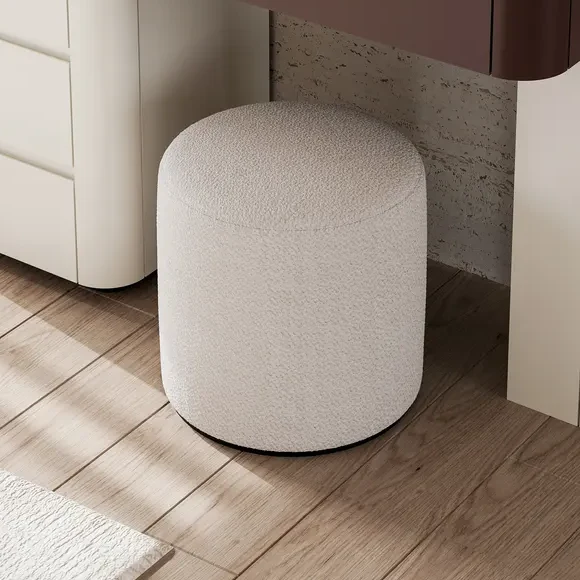
What Is a Pouffe? Uses, Sizes and How to Choose One
Short answer: a pouffe is a small piece of furniture with no back and no arms, used either as a seat on its own or as a footrest — what separates it from an armchair is that it is not part of a "suite" and can be moved around the room as needs change. In a living room it is most often used as a footstool, as extra seating when guests arrive, and as an alternative to a coffee table.
What is a pouffe, and how does it differ from an armchair or a bergère?
An armchair or a bergère comes with a back and arms, and those fix your sitting position. A pouffe is usually a plain cylinder or cube with neither back nor arms, which means it is not tied to a single use. The same pouffe can be where you rest your feet one day, an extra seat around a crowded table the next, and a surface for a tray the day after that. Compared with the bergère we describe as a single-seat armchair in our what is a bergère and how to choose one article, a pouffe is more flexible in function but more limited in seating comfort.
Where is a pouffe used in the living room?
- Footstool: placed in front of a sofa or a bergère so you can stretch your legs out while seated.
- Extra seating: when there are more guests than seats, it is light enough to be carried and pulled over to wherever it is needed.
- Coffee-table alternative: put a tray on top and it becomes a temporary surface for coffee, a book or the remote.
- Transition areas: it also works as somewhere to sit while putting shoes on in a dressing corner, or as an extra seat in the bedroom.
That flexibility is what makes a pouffe a sensible choice instead of a fixed coffee table in a small living room; we covered the floor planning side in our how to furnish a small living room article.
Choosing the material: leather-look or fabric?

Because a pouffe moves around more often than a sofa and is touched more often, the choice of cover matters. Leather-look covers do not absorb liquid, so they are wiped clean; that is a real everyday advantage in homes with children and pets. Fabric-covered pouffes have a warmer look thanks to their texture, but like fabric sofas they are more sensitive to stains. Our article on what the Martindale rating means, where we compare the durability of fabric types, is just as useful when choosing a pouffe.
What determines the size and height of a pouffe?
If it will be used as a footstool, its height should be close to the seat height of the chair it stands in front of; otherwise your legs will not stretch out comfortably. If it will stand in for a coffee table, the same logic applies as for coffee table height — a level you can reach easily from where you sit. We explained that measuring logic in detail in our coffee table sizes and how to choose one article. On the width side, a pouffe should be compact enough not to block the corner it sits in or narrow a walkway; round shapes take up less room than rectangular ones in tight corners.
Should you buy a pouffe on its own or with a suite?
A pouffe is not a compulsory part of a sofa suite; it is a finishing piece added later, as the need appears. So rather than matching its colour exactly to the sofa fabric, choosing it to work with another surface in the room — a table top, a wood tone, the colour of the rug — gives you a more flexible result. Being light enough to carry is part of that same flexibility: it is not tied to one spot.
How do you look after a pouffe?
A leather-look cover is cleaned by wiping it with a slightly damp cloth; because the cover does not hold stains, that is all it takes. On fabric-covered pouffes, dealing with a spill before it dries prevents a permanent mark. With either cover, keeping the piece out of direct sunlight slows fading. We have gathered the general care rules by material in our how to care for furniture article.
You can see a leather-look, cylindrical example on the Bergama Pouffe page, and compare different shapes and colours in the living room pouffe category.
Frequently Asked Questions
What is the difference between a pouffe and a stool?
A stool usually has a hard seating surface and a taller body, and is most often designed for kitchen or bar use. A pouffe is lower, softly padded and shaped for living room use.
How many people does a pouffe seat?
A standard pouffe gives one extra seat. Two people can sit side by side on a wide, rectangular pouffe, but that should not be compared with the comfort of a sofa.
Does a pouffe go with every sofa suite?
Yes, as long as the colour and material work together. The rule is not that the fabric must be identical; it is that the tone families (light-dark, warm-cool) should not clash.
Which rooms can a pouffe be used in?
The living room is the most common, but it is also chosen as an extra seat in a dressing corner, a bedroom and even a teenager's room.